The largest 3D printers you can buy online
These are the largest printers we found for sale on official US stores, sorted by size. Build volume is width × depth × height as each maker states it. Bambu Lab and Elegoo were running sales on October 27, 2026, so we list the sale price and then the regular price.
| Printer | Type | Build volume | Price | Regular |
|---|---|---|---|---|
| Bambu Lab H2D | Filament, enclosed, dual nozzle | 325 × 320 × 325 mm12.8 × 12.6 × 12.8 in, single-nozzle printing | $1,399 | $1,549 |
| Bambu Lab A2L | Filament, open frame | 330 × 320 × 325 mm13.0 × 12.6 × 12.8 in | $439 | $469 |
| Bambu Lab H2S | Filament, enclosed | 340 × 320 × 340 mm13.4 × 12.6 × 13.4 in | $1,049 | $1,199 |
| Elegoo Neptune 4 Max | Filament, open frame | 420 × 420 × 480 mm16.5 × 16.5 × 18.9 in | $359 | $559.99 |
| Elegoo OrangeStorm Giga | Filament, open frame | 800 × 800 × 1000 mm31.5 × 31.5 × 39.4 in | $2,299 | $3,125 |
| Formlabs Form 4L | Resin (MSLA), Basic Package | 353 × 196 × 350 mm13.9 × 7.7 × 13.8 in | $7,125 | — |
The jump from the 420 mm Neptune 4 Max to the 800 mm OrangeStorm Giga is large: the Giga has more than three and a half times the bed area. For resin, Formlabs’ Form 4L is the largest printer here with a published price. Its 353 × 196 × 350 mm build volume suits large detailed parts, not furniture-scale pieces. For everyday printer prices, see our 3D printer cost guide.
Industrial large-format printers
Past about 1 meter, printers become industrial equipment sold through quotes rather than online stores.
| Printer | Type | Build volume |
|---|---|---|
| BigRep ONE | Filament (FDM) | 1005 × 1005 × 1005 mm39.6 × 39.6 × 39.6 in |
| Stratasys F770 | Filament (FDM) | 1000 × 610 × 610 mm39.4 × 24.0 × 24.0 in |
| 3D Systems SLA 750 | Resin (SLA) | 750 × 750 × 550 mm29.5 × 29.5 × 21.7 in |
What is the largest 3D printer in the world?
Guinness World Records lists the largest prototype polymer 3d printer as a machine built by the University of Maine Advanced Structures and Composites Center, measuring 343.61 m³ (12,134.47 ft³). The record was set on October 10, 2019. In April 2024, the university announced a successor it says surpasses that record. These are research machines, not printers you can buy.
What owners learn after buying a large printer
Build volume is the headline, but owners of big printers report the same three surprises: weight, power and long print times.
- Weight and space. In a 10-month review of the OrangeStorm Giga, Major Hardware puts its weight at about 145 kg (320 lb). The heaviest single part is the base, and there was only one spot in the house it could go.
- Household circuits. The same owner found that heating all four bed zones drew more than a 15-amp circuit can supply. They moved the printer to a dedicated 20-amp circuit (12:57). Smaller printers spike too: Carlex DIY measured about 920 W as a Creality K2 Plus started a print.
- Multi-day prints raise the stakes. Dave Tries This spends an hour or two leveling a Neptune 4 Max’s six-wheel bed, because it prevents a failure a few days into a large print. The Giga owner points to the same risk: a 48-hour print faulting partway through (18:57), or a whole spool of filament lost to a failure near the top.
The Giga owner’s verdict on the roughly $2,500 base model was blunt: definitely not worth that
(21:04). That is one owner’s experience, not a test result, but it matches the pattern: the bigger the printer, the more a single failure costs.
How to 3D print something bigger than the bed
Most big prints are not made on big printers. They are split into sections that fit, then joined. This is how a helmet gets made on a desktop printer, and how we build pieces six feet tall or more.
- Cut the model. Slicers can split a model with a plane. Prusa’s cut tool documentation lists “too big to be printed in one piece” as a reason to cut, and the tool can add connectors and dowel pins for assembly.
- Orient each piece. In a helmet build, I Like To Make Stuff printed one section upside down. It was worse for the finish but cut about two days of print time.
- Glue, fill and sand the seams. The same build used 5-minute epoxy to join pieces, then glazing putty and several coats of filler primer, sanded between coats, to hide seams and layer lines.
Every seam needs to line up, hold weight and disappear under the finish. That is where most of the labor in a large piece goes.
How PrintAWorld prints large parts
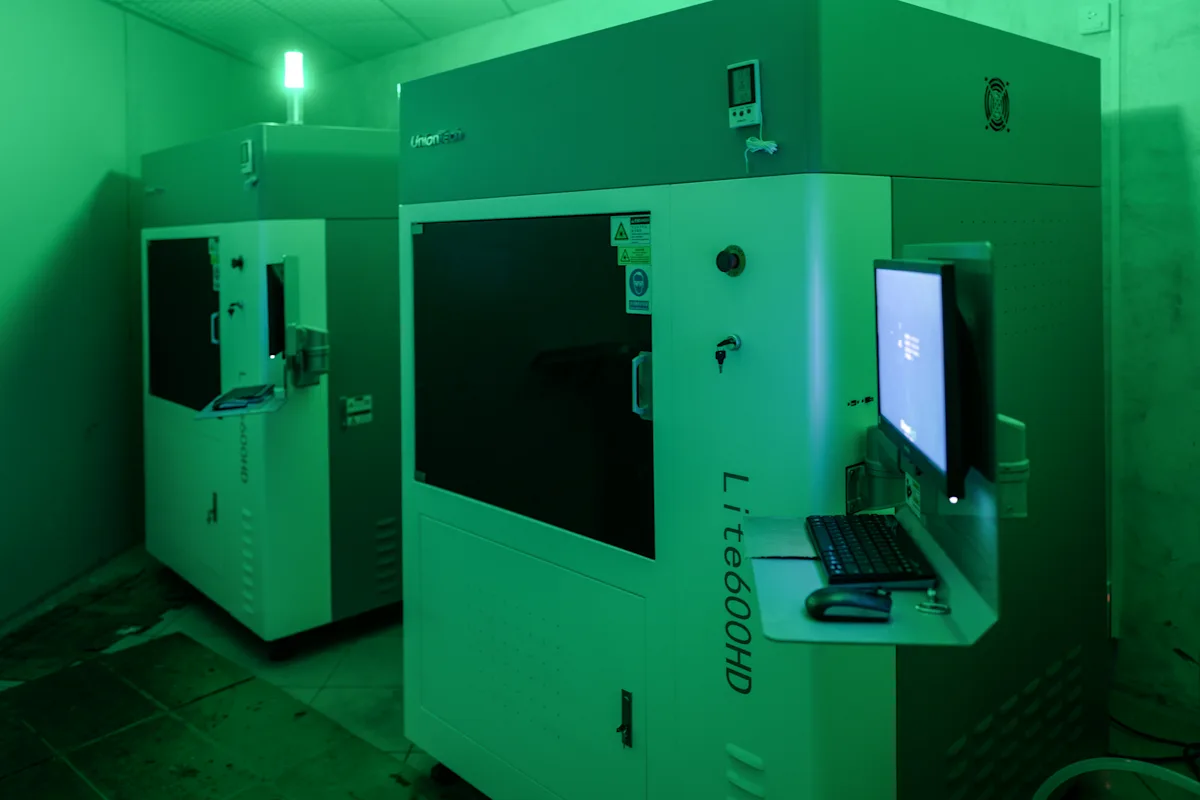
Our large-format printers include UnionTech Lite600HD industrial SLA machines with a 600 × 600 mm (23.6 × 23.6 in) build area. We divide bigger pieces into printable sections, then assemble and finish them, so finished objects can reach six feet or more. Finishing options include sanding, painting and metal plating. Typical projects are sculptures and art pieces, props, displays and architectural models.
Standard large-format projects take about 1–2 weeks, and complex or larger projects may take 1–2 months. We confirm the process, sectioning, schedule and price in a written quote after reviewing your file.
| Your situation | Usually the better fit |
|---|---|
| You print large parts every week and have the room | A large desktop printer, on its own circuit |
| One sculpture, prop, display or architectural model | A service quote for printing and assembly |
| A painted, primed or metal-plated finish | A service that sections, joins and finishes in-house |
| A fixed install or event date | A service with a written schedule |
How we sourced this guide
PrintAWorld did not bench-test the consumer printers listed here. Build volumes come from each maker’s spec page, and prices from official US stores on October 27, 2026. The ownership lessons come from these owner videos:
- The 3D Printer That Broke Me: My 10-Month Battle with the Elegoo OrangeStorm Giga — Major Hardware, January 2025
- Neptune 4 Max - You MUST do these steps to get good prints and fix the problems — Dave Tries This, May 2024
- Testing the Creality K2 Plus Electrical Power Usage in Watts — Carlex DIY, December 2024
- Mandalorian Helmets Using Small 3d Printers — I Like To Make Stuff, January 2021
Common questions about large 3D printers
What is the biggest 3D printer you can buy for home use?
Among printers sold directly on official US stores in late October 2026, the Elegoo OrangeStorm Giga has the largest build volume, at 800 × 800 × 1000 mm (31.5 × 31.5 × 39.4 in), for $2,299 on sale ($3,125 regular). One owner reports it weighs about 145 kg (320 lb) and needed its own 20-amp circuit.
How big can a 3D print be?
One print is limited to the printer’s build volume: roughly 32–48 cm on a side for large desktop printers, and about 1 m for industrial machines such as the BigRep ONE or Stratasys F770. Larger objects are printed in sections and joined, so the finished size is limited by the design, handling and finishing rather than the printer.
How do you 3D print something bigger than the print bed?
Cut the model into sections that fit, add alignment features such as dowels or connectors, print the pieces, then glue, fill and sand the seams. Slicers such as PrusaSlicer include a cut tool that can add connectors and dowel pins.
How much does a large 3D printer cost?
Large desktop printers on official US stores cost about $359–$1,549 in late October 2026, and the 800 mm Elegoo OrangeStorm Giga costs $2,299–$3,125. Formlabs’ large Form 4L resin printer starts at $7,125. Industrial large-format machines from BigRep, Stratasys and 3D Systems are sold by quote.
Is it cheaper to buy a large 3D printer or outsource big prints?
For a one-off sculpture, prop or display, outsourcing usually costs less than buying a printer large enough, plus the space, power, materials and failed multi-day prints. Buying makes more sense if you will print large parts often and have room for the machine.